
Agentic Tools
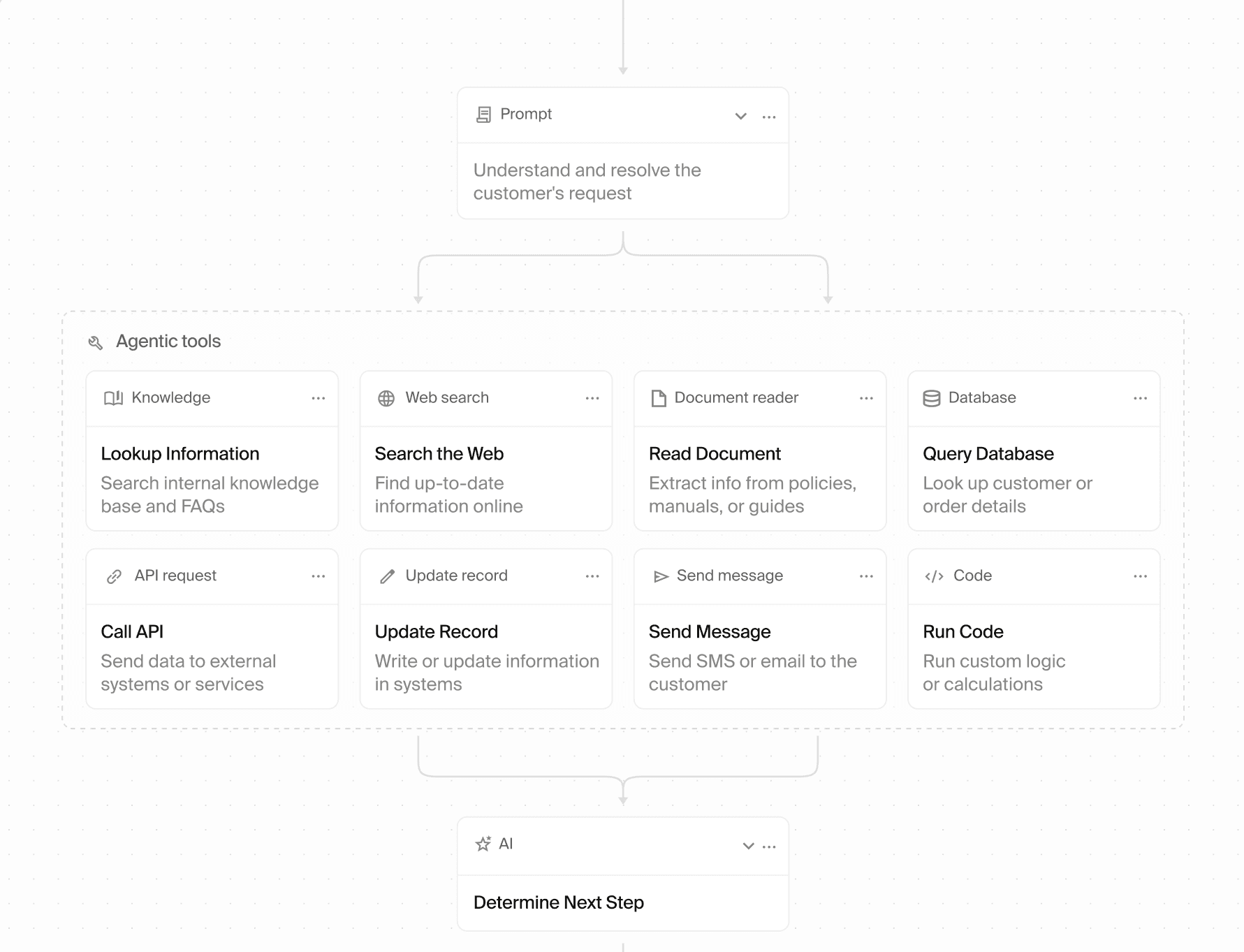
The full set of capabilities agents can invoke mid-workflow to complete a task end-to-end without human intervention.
What are agentic tools?
Agentic tools
Actions an agent can take during or beyond conversation - looking something up, reading a document, browsing a page, writing to a system, or even sending a message. Rather than handing off to a human when a task requires more than talking, agents invoke tools directly within the workflow exactly when needed.
All channels that agents communicate across
Outbound messaging across channels
Agents aren't limited to responding in the channel where a conversation started. Mid-workflow, an agent can send an SMS confirmation, fire an email summary, post a message in Slack or Teams, without breaking the conversation flow.
Inbound message handling
Agents can receive and process inbound messages across channels as part of a workflow - an SMS, an email, a form submission and more, and continue execution based on what comes back. This enables multi-turn, multi-channel interactions spanning several sessions.
File handling
Agents can receive and process file uploads of any type including documents, images, audio, and video sent by a user or passed in from an external system, and act on their contents within the workflow.
For when the task requires more than conversation
Optical Character Recognition (OCR)
Agents invoke OCR mid-workflow to read printed or handwritten content from images, PDFs, and scanned documents. Extracted text is parsed into structured fields and passed directly into the agent's reasoning or written to a downstream system - for invoices, bills of landing, identity documents, forms, and any document that arrives as an image.
Browser agents
Not every system an enterprise operation depends on has an API. Browser agents allow a workflow to navigate a web interface, locate information, fill fields, and extract data the same way a human operator would - so legacy tools, supplier portals, and carrier websites can be incorporated into automated workflows without a custom integration.
RAG and knowledge retrieval
Agents retrieve content from knowledge bases at the point in a conversation where it's needed, matching context to the most relevant content available. Knowledge bases support SOPs, documentation, policies, contracts, and training materials - indexed so agents retrieve precisely rather than broadly, and updated without redeploying the agent.
Image and document understanding
Agents can analyze the content of images and documents - not just extract text, but interpret what's in them, across any channel. A photograph of a damaged shipment sent over WhatsApp, a scanned certificate emailed in, a product image uploaded via chat - agents reason about visual content wherever it arrives and act on it as part of a workflow decision.
Data transformation and computation
Agents can parse API responses, transform data structures, apply business rules, and compute values mid-workflow using code blocks with full programmatic control at any point in execution without leaving the workflow.
External agent delegation via MCP
When a workflow requires a capability that lives in another agent, such as an existing enterprise investment, a specialized model, or a third-party system, the agent can delegate to it via MCP, pass context, wait for a response, and continue seamlessly. Existing agent infrastructure plugs directly into the orchestration without being rebuilt.