
Proprietary voice stack for human-like conversations
A purpose-built voice pipeline engineered for the unpredictability of real enterprise calls
Why HappyRobot's voice AI is different
Our TTS
Most voice AI is built for controlled conditions. Enterprise telephony isn't controlled - callers have accents, background noise, domain-specific terminology, and no patience for robotic responses or awkward pauses. HappyRobot's voice pipeline is a 10-model stack where every component is fine-tuned specifically for live telephony at enterprise scale, not adapted from a general-purpose consumer product.
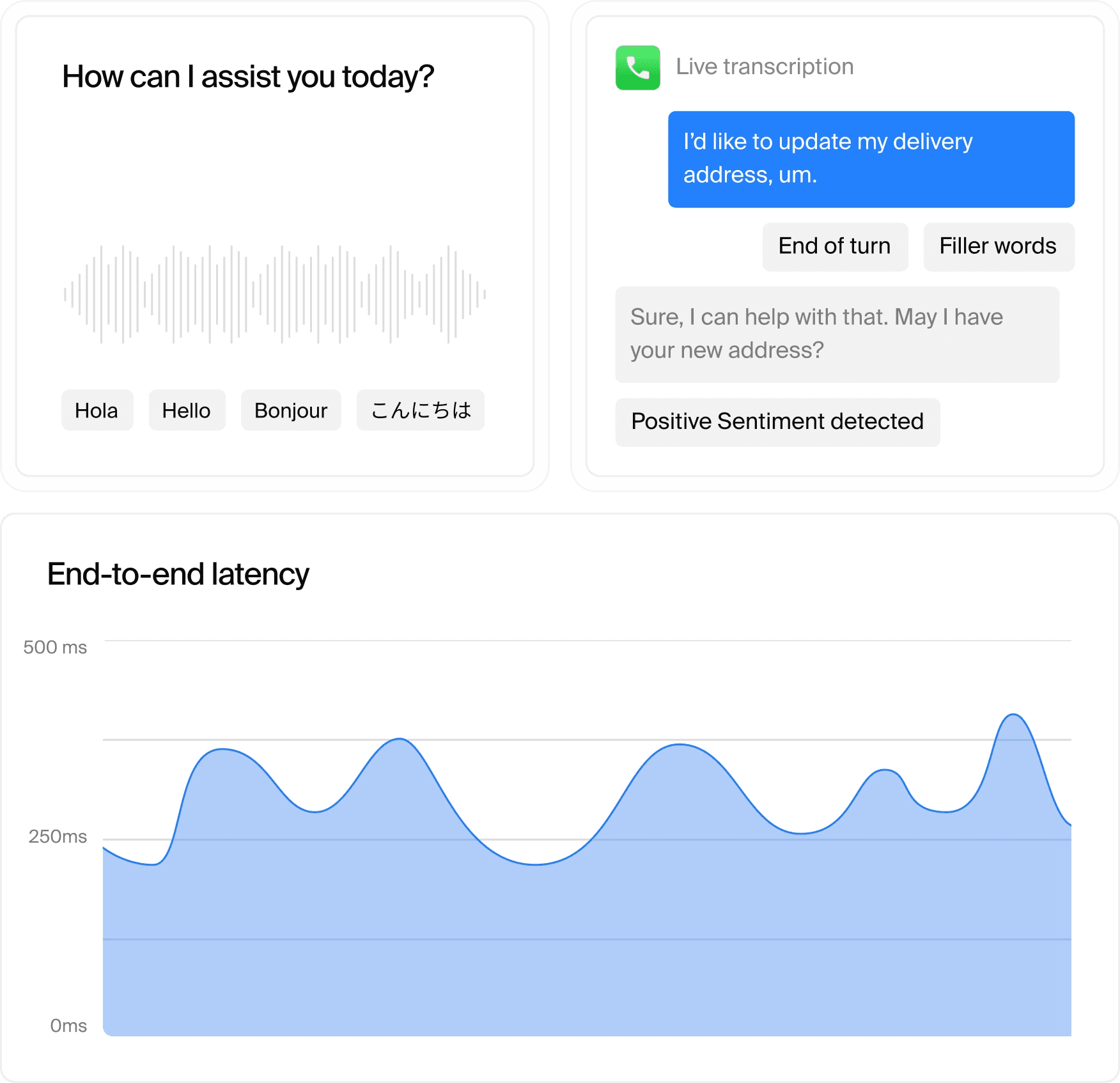
Back-and-forth of a real call without breaking flow
End-of-turn detection
Knowing when a caller has finished speaking versus pausing mid-thought, searching for a word, or trailing off, is a hard problem in voice AI. A dedicated end-of-turn model ensures the agent doesn't cut in too early or wait too long, for a natural conversation rhythm.
Filler and interruption handling
Not every sound mid-call is an interruption. A caller saying "um" or "uh" mid-sentence is thinking, not handing over the floor. A dedicated model distinguishes fillers from genuine interruptions so the agent does not react to every noise.
Voice activity detection
Background noise, hold music, and ambient sound in call center environments can all trigger false positives in basic voice detection systems. Our VAD model is trained to isolate actual speech from everything else that happens on a live call so the agent is focused on what the caller says.
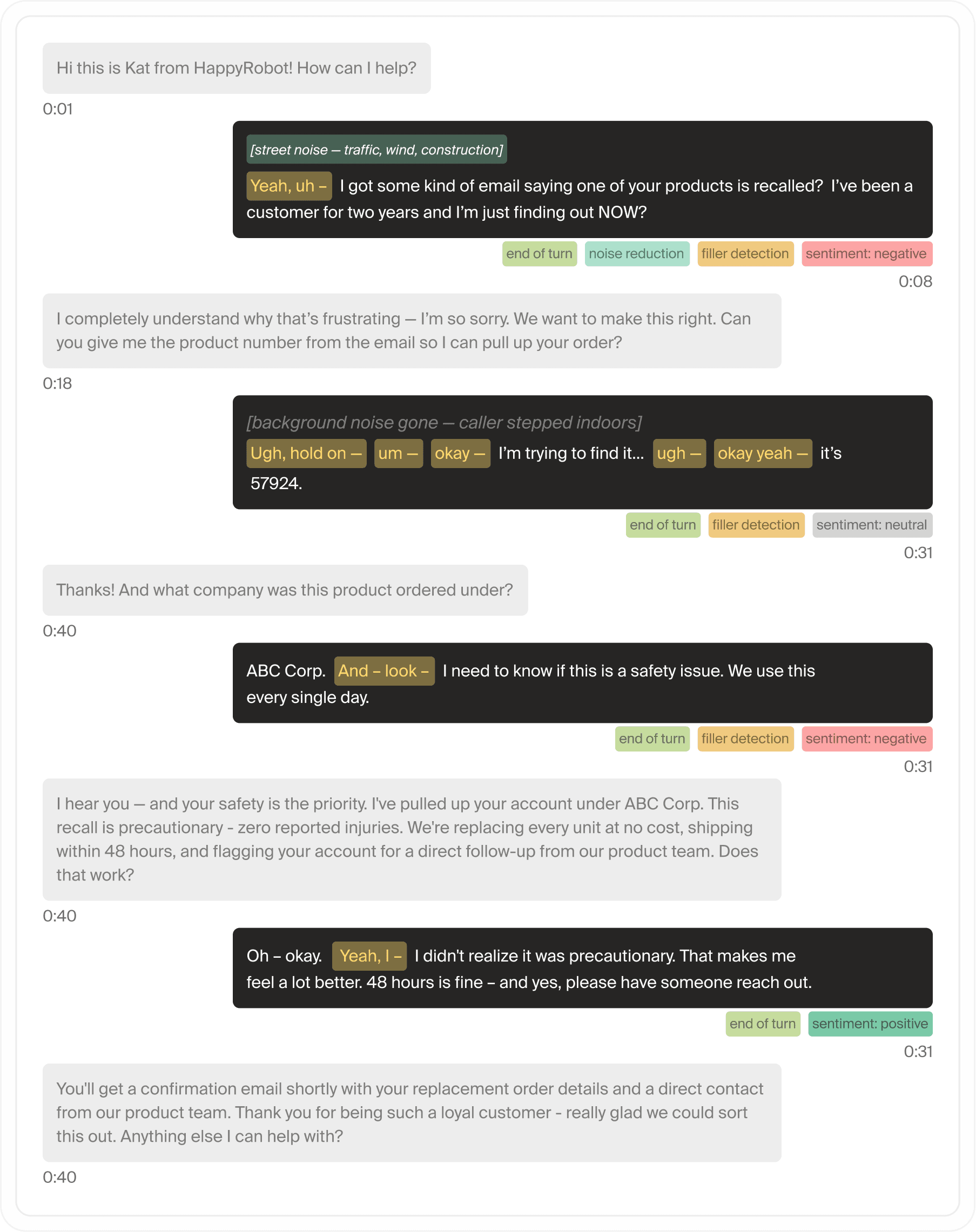
Accuracy on words that matter the most - everything that gets mangled in generic models
Multi-provider transcription with automatic failover
Parallel transcription providers run simultaneously with automatic failover - if one degrades for any reason, the pipeline switches instantly without the caller noticing or the conversation breaking.
Numbers and reference data accuracy
Generic models routinely mishear sequences of digits contained in order numbers, tracking IDs, phone numbers, account references. The transcription stack is specifically tuned for numeric accuracy in enterprise contexts where a single misheard digit breaks a downstream lookup.
Keyword boosting
Domain-specific terms like product codes, carrier names, industry jargon are systematically underperformed by general transcription models. Keyword boosting primes the transcription layer for the specific vocabulary your operation uses, so the terms that matter most to your workflows are the ones captured most accurately.
Callers feel latency long before it shows up as a metric. We optimize and measure each stage separately - transcription, reasoning, TTS, network transit - so any degradation traces instantly to the component causing it
How the agent sounds and why that matters for calls
Fine-tuned Text-to-Speech (TTS) for the real world
Text-to-speech in a live call environment has different requirements than a podcast or a smart speaker. Pronunciation of numbers, dates, abbreviations, and domain-specific terms needs to be consistent and correct. Our TTS model is fine-tuned for telephony delivery, not adapted from a general-purpose voice synthesis product.
Voice matching across providers
When a provider switch happens mid-call due to failover or routing, voice characteristics are preserved so the caller doesn't notice a change in how the agent sounds. Consistency is maintained at the persona level, not just the text level.
30+ languages with matched voice quality
Multilingual support isn't just translation. Each language deployment maintains the same voice quality, latency profile, and conversation model behavior as the primary language. Callers in any supported language get the same experience, not a degraded fallback.